
Student Visa Checklist UAE 2026: Your Complete Document Guide
By Salar Jadoon · Updated July 2026 · Sourced from ICP and GDRFA Dubai
The UAE has become one of the fastest-growing study destinations for South Asian students, and the process runs differently from most Western systems in one key way: your university does almost all the visa legwork for you, acting as your sponsor from the Entry Permit stage right through to residency stamping. This guide is the complete student visa checklist for the UAE — every document, every real cost, and what changes for Pakistani, Indian, and Bangladeshi applicants specifically.
Table of Contents
- What the UAE Student Visa Actually Is
- Student Visa Checklist UAE: The Complete Document List
- Attestation — The Step That Trips Up Most Applicants
- Financial Proof Requirements
- Step-by-Step Process
- Cost Breakdown
- Processing Times
- Country-Specific Notes: Pakistan, India, Bangladesh
- The Golden Visa Route for Outstanding Students
- Working While Studying
- Common Mistakes
- Visa Renewal
- FAQ
What the UAE Student Visa Actually Is
It’s a residence permit tied to enrollment at a licensed UAE institution, valid for one year and renewed annually alongside your academic progress. Unlike most Western study-visa systems, your university acts as your official sponsor throughout — they file your Entry Permit, and later your residency stamping, on your behalf. You’ll deal primarily with ICP (Federal Authority for Identity, Citizenship, Customs and Port Security) federally, or GDRFA if you’re specifically in Dubai.
Roughly 27,000 international students are currently enrolled across UAE institutions, with Pakistani, Indian, and Bangladeshi students forming a meaningful share of that number — Dubai and Abu Dhabi in particular have built a real base of South Asian student communities around universities like the American University of Sharjah, University of Wollongong Dubai, Heriot-Watt Dubai, and Khalifa University.
Student Visa Checklist UAE: The Complete Document List
This is the full student visa checklist UAE applicants need.
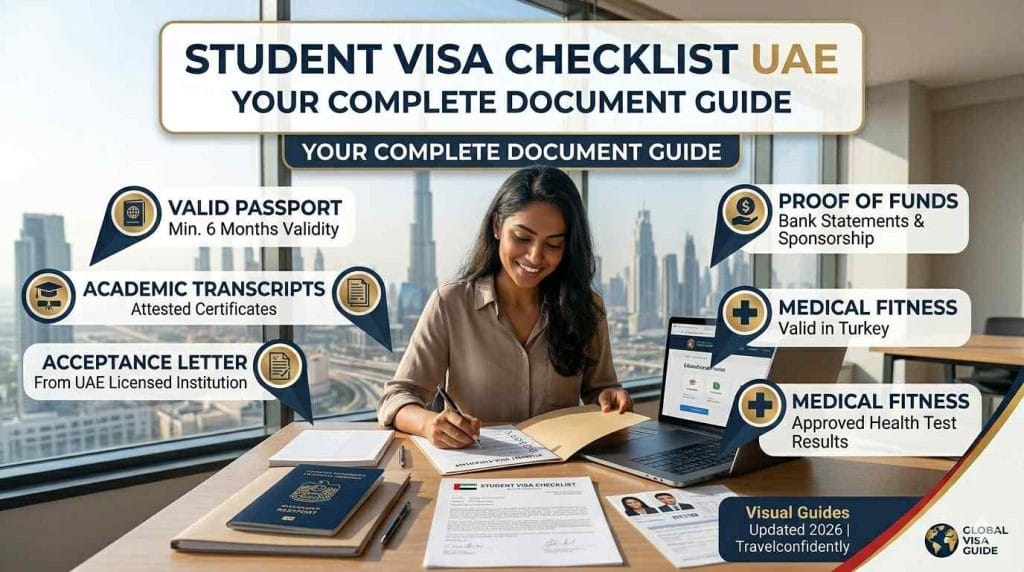
Core documents: – Passport — 6+ months validity minimum (1 year strongly recommended, since visa validity plus any delay can eat into a tight 6-month window), 2+ blank pages, clear color scans of first and last pages – Official acceptance/admission letter from a UAE-licensed institution, stating program name, duration, and enrollment status – Academic transcripts and certificates from your highest completed qualification — these require attestation (see next section) – 4–6 recent passport photos, pure white background, face covering roughly 80% of the frame, no glasses or head covering except religious – Proof of financial resources — bank statements plus, where applicable, a sponsor letter – Medical fitness test results — completed inside the UAE after arrival, not before – Valid health insurance covering your full stay – Completed visa application form and fee payment receipts
Attestation — The Step That Trips Up Most Applicants
This is the single most underestimated part of the whole student visa checklist UAE applicants face, and it’s worth understanding clearly before you start.
Your academic certificates need a full attestation chain before UAE authorities will accept them: first notarized/attested in your home country by the relevant education board or HEC (Pakistan) / state authority (India) / Ministry of Education (Bangladesh), then by your country’s Ministry of Foreign Affairs, and finally by the UAE Embassy in your home country. Only once all three stamps are in place does the document count as valid for UAE purposes.
This chain takes real time — typically 4–8 weeks depending on country and how busy the relevant offices are. Starting it the moment you receive your acceptance letter, rather than waiting until closer to your intended travel date, is the single most effective thing you can do to avoid delay.
Financial Proof Requirements
- Bank statements covering the last 3–6 months, showing funds sufficient to cover tuition and living expenses for the year
- A sponsor letter if a parent or relative is funding your studies, along with their bank statements
- Original, bank-stamped statements are generally preferred over printed online PDFs, particularly for Pakistani and Bangladeshi applicants
- No fixed published minimum balance exists — the expectation is that funds visibly and comfortably cover your specific institution’s tuition plus a reasonable estimate of living costs, which vary considerably between Dubai, Abu Dhabi, and Sharjah
Step-by-Step Process
- Secure admission — apply, pay your initial tuition deposit, receive your official acceptance letter.
- Your university applies for your Entry Permit — you send them your checklist documents; they handle the ICP/GDRFA filing. Typically 1–3 weeks.
- Travel to the UAE — print your electronic Entry Permit in color, present it at immigration on arrival.
- Complete your medical fitness test — immediately after arrival, at an approved government medical center. Blood sample plus chest X-ray; results in 24–48 hours.
- Apply for your Emirates ID — biometrics (fingerprints, digital photo) at an ICP typing center.
- Visa stamping — your university submits your medical results and passport to immigration for residency stamping.
- Receive your physical Emirates ID — arrives a few days after stamping. You’re now a registered UAE resident.
Cost Breakdown
| Item | Typical Cost (AED) |
| Entry Permit fee | 300–500 |
| Medical test fee | 300–350 |
| Emirates ID fee | ~170/year of validity |
| Visa stamping fee | 400–500 |
| Health insurance | 600–2,000+/year |
| University processing fee | Varies — some institutions bundle this into tuition |
Costs shift slightly between Emirates and between institutions — always confirm exact figures directly with your specific university’s admissions office, since many bundle several of these fees together into a single “visa processing charge.”
Processing Times
Total time from submitting your documents to your university through to holding your stamped residency visa typically runs 2–4 weeks, though this can extend if your attestation chain isn’t complete when your university tries to file, or if your medical test flags something requiring follow-up.
Country-Specific Notes: Pakistan, India, Bangladesh
Pakistan. Attestation runs through HEC (Higher Education Commission) for degree certificates, then Pakistan’s MOFA, then the UAE Embassy Islamabad. Budget 6–8 weeks for this chain specifically — Pakistani attestation offices tend to run slower than India’s equivalent process. Bank statements should be original and bank-stamped; online PDF statements are frequently questioned.
India. Attestation runs through the relevant State HRD department (or the certificate-issuing university directly for some degrees), then India’s MEA, then the UAE Embassy New Delhi (or the relevant consulate). Generally faster than Pakistan’s chain — often 4–6 weeks. Indian students form one of the largest South Asian student cohorts in UAE institutions, and several universities run India-specific scholarship and fee-waiver programs worth asking admissions about directly.
Bangladesh. Attestation runs through the Ministry of Education, then Bangladesh’s MOFA, then the UAE Embassy Dhaka. Similar timeline to Pakistan’s, 6–8 weeks. A Bank Solvency Certificate alongside standard statements is commonly expected and strengthens the financial proof section meaningfully.
Across all three countries, the practical advice is the same: start the attestation chain the day you accept your offer, not when your university asks for final documents — it is consistently the single biggest cause of delayed Entry Permit filing.
The Golden Visa Route for Outstanding Students
High-performing students have a genuine long-term residency option worth knowing about early. The 10-year Golden Visa is available to:
- High school students scoring 95%+ in final exams
- University students maintaining a cumulative GPA of 3.75+
- At institutions classified Category A or B by the Ministry of Education
No sponsor is required for this visa, and holders can sponsor their own parents — a real practical benefit for a family considering a longer-term UAE presence around a student’s studies. If your grades are trending toward this threshold, it’s worth structuring your academic planning with it in mind from early in your program rather than discovering the option in your final year.
Working While Studying
Part-time work is allowed but requires a formal work permit from MOHRE (Ministry of Human Resources and Emiratisation), along with a No Objection Certificate (NOC) from your university — you can’t simply take a job without both pieces in place.
Internships are actively encouraged and widely available, given the concentration of global company offices in Dubai specifically. Your university’s career center is the standard starting point, and any internship contract should be verified as legally structured before you sign — an unpaid arrangement still needs to follow UAE labor rules correctly.
Common Mistakes
Incomplete attestation. By far the most common and most avoidable delay — starting this chain late is the single biggest cause of Entry Permit filing delays across all three South Asian countries.
Applying with a soon-to-expire passport. Renew well ahead — a passport with barely 6 months left creates risk if any stage of the process runs long.
Poor photo quality or wrong specifications. Old photos, wrong background, or non-compliant format cause avoidable rejection at the university filing stage.
A failed medical test. Testing positive for a communicable disease results in visa refusal regardless of how complete everything else is — worth being aware of any relevant health considerations before committing to travel plans and deposits.
Typos on application forms. Spelling mismatches between your form and your passport are a simple, entirely preventable cause of processing delay.
Prior legal issues in the UAE or GCC. These trigger security screening that can block the visa — relevant mainly for students who’ve previously visited or lived in the region.
Visa Renewal
Student visas run one year at a time and must be renewed annually — start the process a month before expiration. Renewal requires passing your exams, maintaining reasonable attendance, a new medical test, and paying the renewal fees again. Letting the visa lapse brings daily fines and risks a travel ban — track your expiration date carefully and don’t leave renewal to the last week.
FAQ
Common questions about the student visa checklist UAE process:
How long does the UAE student visa take to process? Typically 2–4 weeks once all documents, including a completed attestation chain, are submitted to your university.
What’s the biggest cause of delay for Pakistani, Indian, or Bangladeshi applicants? Incomplete academic certificate attestation — the home-country-MOFA-UAE Embassy chain takes 4–8 weeks depending on country, and starting it late is the most common avoidable bottleneck.
Can I switch universities while in the UAE? Yes, but it requires paperwork — your new university applies for a new visa, and your old one must be cancelled first before the new filing proceeds.
Do I need IELTS for the visa itself? No — the visa process itself doesn’t require it, though your specific institution will almost certainly require English proficiency scores as part of admission, separate from the visa documents.
Can I stay in the UAE after graduation? Yes — options include securing a job and converting to a work visa, qualifying for the Golden Visa if your academic record meets the threshold, or using the standard grace period to either change status or depart.
Is there an age limit for a student visa? No strict upper limit for university-level students, though a significant gap since your last qualification may require an explanatory letter as part of your application.
What happens if I fail classes during the year? Your university can cancel their sponsorship of your visa — maintaining minimum academic standing set by your institution is a condition of keeping your residency status active.
See our complete Student Visa Hub for guides covering other major study destinations. Sourced from ICP and GDRFA Dubai, reviewed periodically for accuracy.