
Digital Nomad Visa USA Requirements 2026: Complete Guide for Remote Workers
By Global Visa Guide Editorial · Updated April 2026 · 15 min read

Here is the honest truth: the USA does not have a dedicated digital nomad visa in 2026. But that does not mean the dream is dead. Remote workers from around the world are still living and working legally inside the United States they just use different visa pathways. This guide breaks down every real option available, what each one requires, what it costs, and which one fits your situation best.
The United States is one of the most desirable destinations on the planet for remote workers. New York. San Francisco. Austin. Miami. These cities offer world-class infrastructure, fast internet, massive professional networks, and a quality of life that is hard to match anywhere in the world.
Every year, thousands of digital nomads search for a USA remote work visa. Most of them find confusing, outdated, or contradictory information. Some apply for the wrong visa. Others work in legal grey areas without fully understanding the risks. And a small number end up facing serious immigration consequences.
This guide gives you the clear picture. It covers the digital nomad visa USA requirements 2026 across every relevant pathway B-1/B-2 Tourist Visa, ESTA and Visa Waiver Program, O-1 Extraordinary Ability Visa, E-2 Investor Visa, and more. Read every section before you decide which route to take.Table of Contents
- Does the USA Have a Digital Nomad Visa in 2026?
- Best Visa Options for Digital Nomads in the USA
- Option 1: B-1/B-2 Visitor Visa Most Common Route
- Option 2: ESTA and the Visa Waiver Program
- Option 3: O-1 Visa For Extraordinary Talent
- Option 4: E-2 Treaty Investor Visa
- Option 5: H-1B Specialty Occupation Visa
- Digital Nomad Visa USA Requirements 2026 Full Breakdown
- Required Documents Checklist
- How to Apply Step-by-Step
- Cost Breakdown for 2026
- Processing Times
- The Grey Area: Remote Work on a Tourist Visa
- US Tax Rules for Remote Workers
- Best US Cities for Digital Nomads in 2026
- Common Mistakes to Avoid
- Frequently Asked Questions
size=3 width=”100%” align=center>
Does the USA Have a Digital Nomad Visa in 2026?
No. The United States does not offer a dedicated digital nomad visa in 2026. The US Department of State and USCIS have not created a specific remote work visa category. Unlike the UAE, Portugal, Spain, or over 50 other countries, the USA has not launched a formal programme for location-independent workers.
This surprises many people. The US is home to the world’s largest remote work culture. Millions of Americans work remotely. But the immigration system was not built with digital nomads in mind and reforming it moves very slowly.
So what do remote workers actually do? They use existing visa categories that were designed for other purposes. Some work beautifully for nomads. Others come with strict conditions and real legal risks if misused. The key is understanding which visa applies to your specific situation and following its rules precisely.
Important disclaimer: US immigration law is complex and strictly enforced. This article provides general information only not legal advice. If you are uncertain about your visa situation, consult a licensed US immigration attorney before you travel.
Best Visa Options for Digital Nomads in the USA 2026
There are five main pathways that remote workers use to stay in the United States legally. Each one serves a different profile of applicant. Here is a quick overview before we go into detail on each option.
| Visa Type | Stay Duration | Best For | Fee (USD) |
| B-1/B-2 Visitor Visa | Up to 6 months per entry (10-yr validity) | All nationalities, short-to-medium stays | ~$185 |
| ESTA / Visa Waiver | Up to 90 days per visit | 40 eligible countries fastest option | ~$21 |
| O-1 Visa | Up to 3 years (renewable) | Exceptional talent in any field | $460 + legal fees |
| E-2 Treaty Investor Visa | 2–5 years (renewable) | Business owners from treaty countries | $205 + investment |
| H-1B Specialty Occupation | 3 years (extendable to 6) | Employer-sponsored skilled workers | $730+ (employer pays) |
Option 1: B-1/B-2 Visitor Visa The Most Common Route
The B-1/B-2 Visitor Visa is the most widely used option for digital nomads visiting the USA. The B-1 covers business activities. The B-2 covers tourism. In practice, both are issued together as a single combined visa.
This visa allows stays of up to six months per visit. The validity period can be up to ten years depending on your nationality and reciprocity agreements. That means you can enter the US multiple times over a decade on a single visa though each stay is capped at the duration an immigration officer grants you at the border.
What Remote Work Is and Is Not Allowed
This is the most important section for digital nomads. Read it carefully.
The B-1/B-2 visa does not authorize you to work for US employers or earn income from US sources while inside the country. Working for a US company, invoicing US clients, or performing services for US-based organizations while on this visa violates its conditions.
However and this is the critical distinction working remotely for a foreign employer while physically in the US falls into a debated grey area. Your employer is abroad. Your income comes from abroad. You are not competing for jobs in the US labor market. Many immigration lawyers argue this is permissible. But it is not officially authorized. The risk is real.
The risk you need to understand: US Customs and Border Protection (CBP) officers have broad discretion. If they determine that you are entering the US primarily to work rather than to visit, they can deny your entry even on a valid visa. Repeated long stays, evidence of work activity, or inconsistent answers at the border can all trigger scrutiny. Know your situation and answer honestly.
Key Requirements for the B-1/B-2 Visa
- Valid passport with at least six months validity beyond your intended stay
- Completed DS-160 online application form
- Passport-size photograph meeting US government photo standards
- In-person interview at a US embassy or consulate
- Proof of strong ties to your home country employment, property, family, or financial commitments
- Evidence of sufficient funds to support your stay without working in the US
- Proof of onward or return travel
- No intention to immigrate permanently to the USA
Option 2: ESTA and the Visa Waiver Program Fastest Entry
If your country participates in the US Visa Waiver Program (VWP), you do not need a B-1/B-2 visa at all. You apply for ESTA the Electronic System for Travel Authorization online. It costs just $21 and approval typically arrives within 72 hours.
ESTA allows stays of up to 90 days per visit. You can make multiple trips to the US during a two-year ESTA authorization period. It is the fastest, cheapest, and simplest way to enter the USA for eligible nationalities.
ESTA Eligible Countries Include
The Visa Waiver Program currently covers 42 countries. These include the UK, Germany, France, Italy, Spain, the Netherlands, Sweden, Japan, South Korea, Singapore, Australia, and New Zealand among others. Check the US Department of Homeland Security website for the current full list.
Key Requirements for ESTA
- Passport from a VWP-eligible country with an embedded electronic chip
- Travel purpose must be tourism, business, or transit not employment
- No previous US visa refusals or overstays on any prior visit
- No criminal record that would disqualify entry
- Return or onward ticket out of the United States
- Not have previously traveled to Cuba, Iran, Iraq, Libya, North Korea, Somalia, Sudan, Syria, or Yemen after March 1, 2011 (otherwise must apply for a B-1/B-2 visa)
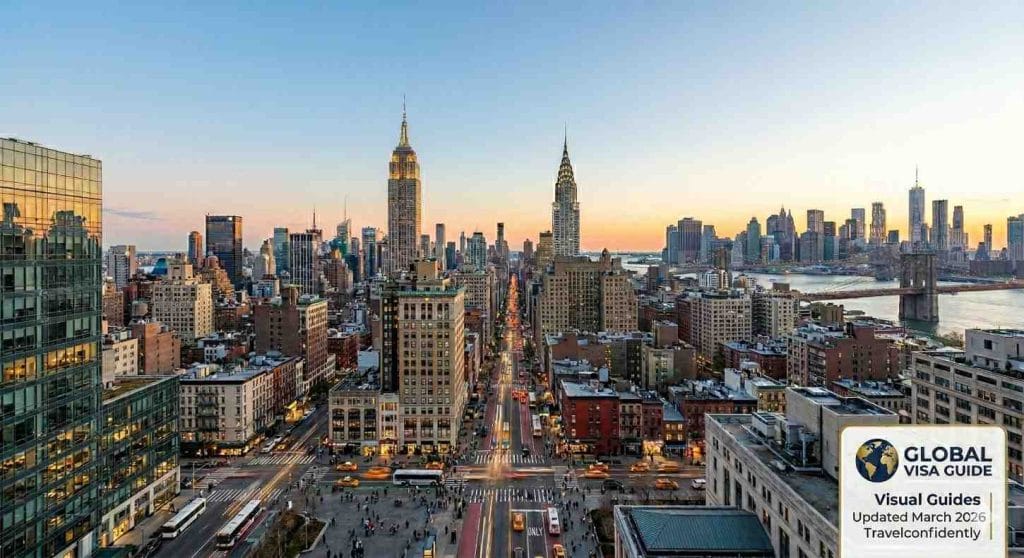
ESTA tip: Apply for ESTA at least 72 hours before your flight but ideally several days ahead. Most approvals arrive quickly, but some applications go into manual review. Do not book non-refundable flights before you have ESTA authorization confirmed. US cities like New York, Austin, and Miami offer world-class co-working environments for remote professionals in 2026.
Option 3: O-1 Visa For Extraordinary Talent
The O-1 visa is the most legitimate long-term option for digital nomads with exceptional skills. It is designed for individuals with extraordinary ability in science, arts, education, business, athletics, or the film and TV industry.
“Extraordinary ability” sounds intimidating. But immigration lawyers have successfully argued this standard for a wide range of professionals including successful online entrepreneurs, widely-published writers, award-winning designers, prominent tech consultants, and influential content creators with significant platforms.
Who Qualifies for an O-1 Visa?
You need to demonstrate sustained national or international acclaim. Evidence typically includes a combination of the following:
- Major prizes or awards in your field
- Membership in prestigious professional associations that require outstanding achievement
- Published articles about you in major media or professional publications
- Judging the work of others in your field
- Original scientific, scholarly, artistic, athletic, or business contributions of major significance
- High salary or remuneration significantly above others in your field
- Critical or essential roles in distinguished organizations
Key Features of the O-1 Visa
- Valid for up to three years renewable indefinitely in one-year increments
- Requires a US sponsor usually a US employer, agent, or organization
- Allows you to work legally for the sponsoring entity in the US
- Family members can come on O-3 visas (no work authorization)
- No annual cap unlike the H-1B, it is not subject to a lottery
Reality check: The O-1 visa requires a US petitioner or agent to file on your behalf. You cannot self-petition. If you are a freelancer with no US-based clients or employers, finding a qualifying sponsor is the main challenge. Many immigration attorneys who specialize in O-1 can also act as your qualifying agent.
Option 4: E-2 Treaty Investor Visa For Business Owners
The E-2 Investor Visa is one of the most underrated options for digital nomads who own businesses. It allows nationals of specific treaty countries to live and work in the USA as long as they invest a “substantial amount” in a real US business.
There is no fixed minimum investment amount defined by US law. But in practice, immigration officers look for investments that are substantial relative to the total cost of the business. Most successful E-2 applications involve investments of USD $50,000 or more. Some digital nomads use this to set up a legitimate US-based business for their existing remote work operations.
Key Requirements for the E-2 Visa
- Citizenship of a country that has a treaty of commerce and navigation with the USA currently over 80 countries
- Substantial investment in a bona fide US enterprise
- The investment must be real, at risk, and committed not just promised
- The business must generate more than just enough income to support the investor
- You must have at least 50% ownership and control of the enterprise
- You must be coming to the US to develop and direct the business
Key Features of the E-2 Visa
- Initial visa validity of two to five years depending on your nationality
- Renewable indefinitely as long as the business continues to operate
- Spouse receives work authorization automatically on E-2 dependent status
- Children under 21 can accompany you as dependents
- No path to permanent residency directly but E-2 can be a stepping stone
E-2 eligible countries include: UK, Germany, France, Italy, Japan, South Korea, Pakistan, Turkey, India (partial), Canada, and many others. Pakistan is notably one of the E-2 treaty countries making this an option for Pakistani digital nomad entrepreneurs with a viable US business idea.
Option 5: H-1B Specialty Occupation Visa
The H-1B visa is the classic US work visa for skilled professionals. It requires sponsorship from a US employer. It is valid for three years and extendable to six. It allows you to work legally in the United States for the sponsoring company.
For most traditional digital nomads freelancers and remote workers without a US employer the H-1B is not a realistic option. The visa requires a US employer to file a petition on your behalf. The annual cap of 85,000 H-1B visas means most applicants go through a lottery. Competition is intense.
However, if you work for a US-based tech company, consulting firm, or multinational that wants to sponsor you, the H-1B remains one of the most established pathways to long-term legal work in the USA.
Alternative to consider: The L-1 visa transfers employees from an overseas office of a multinational company to its US operations. If your current employer has both an overseas office and a US presence, ask your HR team whether an L-1 transfer is possible. It bypasses the H-1B lottery entirely.
Digital Nomad Visa USA Requirements 2026 Full Breakdown
Here is a consolidated view of the core digital nomad visa USA requirements 2026 for each major pathway. Use this as your quick-reference guide before you start gathering documents.
| Requirement | B-1/B-2 | ESTA | O-1 | E-2 |
| Valid Passport | ✓ (6+ months) | ✓ (VWP country, chip) | ✓ | ✓ (treaty country) |
| DS-160 Form | ✓ Mandatory | ✗ Not required | ✓ Mandatory | ✓ Mandatory |
| Embassy Interview | ✓ Required | ✗ Not required | ✓ Required | ✓ Required |
| US Sponsor / Petitioner | ✗ Not needed | ✗ Not needed | ✓ Required | ✗ Self-sponsored |
| Proof of Funds | ✓ Recommended | ✓ May be checked | Employment income | Investment proof |
| Home Country Ties | ✓ Strong ties required | ✓ Return ticket needed | ✗ Not applicable | ✗ Not applicable |
| Health Insurance | Recommended | Recommended | Recommended | Recommended |
Required Documents Checklist
Get every document on this list ready before you start your application. Incomplete submissions are the primary reason for visa delays and denials. All documents submitted to US embassies must be in English or accompanied by a certified English translation.
For B-1/B-2 Visa
- Valid passport must be valid for at least six months beyond your intended stay
- Completed DS-160 nonimmigrant visa application form online at ceac.state.gov
- Visa application fee payment receipt (MRV fee approximately USD $185)
- Recent passport-sized photograph meeting US government photo specifications
- Interview appointment confirmation letter
- Proof of strong ties to your home country employment letter, property documents, bank statements, family ties
- Financial evidence bank statements showing you can support your stay without working in the US
- Return or onward travel itinerary
- Travel insurance (not mandatory but strongly recommended)
For O-1 Visa (Filed by Petitioner)
- Form I-129 Petition for Nonimmigrant Worker filed by your US sponsor
- Extensive documentation of extraordinary ability awards, media coverage, publications, salary evidence
- Consultation letter from a relevant US peer group or labor organization
- Contract between petitioner and beneficiary
- Itinerary of planned events and activities in the US
- Legal counsel is strongly recommended for O-1 petitions
For E-2 Visa
- Completed DS-160 form and visa application fee
- Proof of citizenship from an E-2 treaty country
- Comprehensive business plan for your US enterprise
- Evidence of funds invested or irrevocably committed bank transfers, purchase agreements, receipts
- Business registration documents EIN, articles of incorporation, operating agreement
- Proof that the investment is substantial and at risk
- Evidence of your intent to develop and direct the business
Tip from Global Visa Guide: For B-1/B-2 visas, the “ties to home country” section is where most applications succeed or fail. Give clear, specific evidence not vague statements. A letter from your employer, a lease agreement, or bank statements showing ongoing financial commitments at home all help significantly.
How to Apply Step-by-Step
Applying for the B-1/B-2 Visitor Visa
Step 1: Complete the DS-160 Form. Go to ceac.state.gov. Fill in the online form for nonimmigrant visa applications. Save your application ID as you go. The form is long set aside 45 to 60 minutes to complete it properly.
Step 2: Pay the MRV Application Fee. Pay the non-refundable Machine Readable Visa (MRV) fee of approximately USD $185. Keep your payment receipt you need it to schedule your interview.
Step 3: Schedule Your Interview. Book your interview appointment at the nearest US Embassy or Consulate. In 2026, wait times for interview appointments vary significantly by country and city. Popular US missions in India, Pakistan, Nigeria, and Brazil often have wait times of several weeks to several months. Book early.
Step 4: Prepare Your Documents. Gather every document from the checklist above. Organize them in a clear folder. Do not show up at the interview with loose, disorganized papers it creates a poor impression.
Step 5: Attend Your Visa Interview. Arrive early. Dress professionally. Answer every question honestly and concisely. The interview for a B-1/B-2 visa is typically short five to ten minutes. The officer is assessing whether you have genuine non-immigrant intent and sufficient ties to your home country.
Step 6: Wait for Processing. After your interview, your passport is retained for visa processing. Most B-1/B-2 visas process within two to five business days after a positive interview. Some applications go into administrative processing, which can take several weeks.
Applying for ESTA
Go to the official ESTA website at esta.cbp.dhs.gov. Create an application and fill in your travel and passport details. Pay the $21 fee. You will receive one of three responses Authorization Approved, Travel Not Authorized, or Pending. Apply at least 72 hours before travel. Do not use third-party ESTA sites that charge inflated fees.
Cost Breakdown for 2026
Here is a realistic look at what you will spend on your US visa application in 2026. Budget beyond just the visa fee the total cost is always higher than the application fee alone.
| Expense Item | Estimated Cost (USD) |
| B-1/B-2 MRV Application Fee | ~$185 |
| ESTA Authorization Fee | ~$21 |
| O-1 Visa Filing Fee (I-129) | ~$460 (plus premium processing $2,805 if needed) |
| E-2 Visa Application Fee | ~$205 |
| Immigration Attorney Fee | $1,500 – $5,000+ (O-1 and E-2) |
| Travel Health Insurance (per month) | $50 – $200/month |
| Medical Examination (if required) | $200 – $500 |
| Document Translation / Notarization | $100 – $500 |
Health insurance note: The United States has no universal public healthcare system. A single emergency room visit can cost thousands of dollars without insurance. Health insurance for your entire US stay is not legally required for most visitor visas but skipping it is a serious financial risk. Buy a comprehensive international health insurance plan before you travel.
Processing Times in 2026
| Visa Type | Typical Processing Time |
| ESTA | Immediate to 72 hours sometimes longer for manual review |
| B-1/B-2 (after interview) | 2 – 5 business days after positive interview; up to several weeks for administrative processing |
| Interview appointment wait time | Varies widely a few days to several months depending on the embassy and country |
| O-1 Petition | Standard: 3 – 6 months. Premium Processing: 15 business days |
| E-2 Visa | 2 – 4 months from filing to interview and decision |
Plan ahead: US embassy interview wait times vary dramatically by country. In 2026, applicants in some high-demand countries wait three to six months just for a B-1/B-2 interview slot. Use the official US Visa Appointment Wait Times tool at travel.state.gov to check current wait times at specific embassies before you plan your travel.
The Grey Area: Remote Work on a Tourist Visa
This is the topic every digital nomad wants a straight answer on. Here is as straight as it gets.
Working for a foreign employer remotely while physically inside the US on a B-1/B-2 or ESTA is not explicitly authorized. It is also not explicitly prohibited in all situations. This creates a grey area that immigration lawyers debate actively.
The key distinction US immigration law draws is between “working in the US” and “working from the US.” If your employer is abroad, your income comes from abroad, and you are not displacing a US worker or competing in the US labor market, many attorneys argue that staying on a visitor visa while doing remote work is defensible.
But the risk is real. CBP officers can question your intent. They can deny entry. They can revoke your visa. And they can flag your record for future travel. US immigration does not forgive easily.
Practical Risk Factors That Increase Scrutiny
- Staying for very long periods on successive visitor entries especially close to the 180-day mark
- Carrying work equipment multiple laptops, external monitors, professional camera setups that suggest full-time work activity
- Having US-based clients or receiving payments from US sources
- Social media presence that clearly shows you are “working from the US” publicly
- Answering inconsistently when asked about your purpose of visit at the border
The bottom line: Remote work on a visitor visa carries legal risk in the USA. The extent of that risk depends on your specific situation. If you plan to stay for extended periods, consider a more appropriate long-term visa pathway. If your stays are short and your work is clearly for overseas clients, the risk is lower but not zero. Consult an immigration attorney if you are uncertain.
US Tax Rules for Remote Workers in 2026
Tax is where many people visiting the USA get caught completely off guard. US tax law applies to physical presence not just citizenship or residency. Understand the rules before you spend more than a few months in the country.
The Substantial Presence Test
If you spend 183 days or more in the US during a calendar year calculated using a three-year weighted formula the IRS considers you a US tax resident. That means you owe US income tax on your worldwide income. Not just US-source income. Everything.
Short Stays Are Generally Safe
Most digital nomads on visitor visas stay well below 183 days per year. Short stays do not trigger US tax residency. Your income from foreign clients remains taxable only in your home country.
For US Citizens and Green Card Holders
US citizens and permanent residents pay US taxes on worldwide income regardless of where they live or work. The Foreign Earned Income Exclusion (FEIE) allows you to exclude up to USD $132,900 of foreign-earned income for the 2026 tax year but only if you meet the Physical Presence Test (330 days abroad in 12 months) or the Bona Fide Residence Test.
Always consult a tax professional. US tax law is complex, and the consequences of getting it wrong are serious. An IRS-enrolled agent or CPA specializing in expat taxes can clarify your obligations and help you minimize your tax burden legally.
Best US Cities for Digital Nomads in 2026
The United States is enormous. Your experience as a digital nomad will vary dramatically depending on where you base yourself. Here are the top choices in 2026.
New York City
The world’s most iconic city. Unmatched networking opportunities. Exceptional co-working spaces. Fast internet. An incredibly diverse professional community. It is expensive but for many digital nomads, the energy and connections are worth every dollar.
Austin, Texas
Austin has become the number one destination for remote workers and tech entrepreneurs in the US. No state income tax in Texas. Lower cost of living than NYC or San Francisco. A thriving startup scene. Warm weather. Strong digital nomad community. Many professionals relocate here permanently after spending time on visitor visas.
Miami, Florida
Miami’s digital nomad scene exploded after 2020 and has not slowed down. No state income tax in Florida. Latin American cultural connections. Excellent weather. A strong international business community and growing tech sector. Wynwood and Brickell are packed with co-working spaces and remote-work-friendly cafes.
San Francisco, California
The global capital of technology. If you work in tech, product, or venture capital, being in San Francisco puts you in the center of the world. It is expensive. It is competitive. And the networking opportunities are genuinely unmatched anywhere on earth.
Smaller Cities Worth Considering
Tucson, Arizona, Medellín-style hubs are emerging across the American South and Southwest. Cities like Boise, Idaho, Raleigh, North Carolina, and Nashville, Tennessee offer lower costs, good internet infrastructure, and growing remote work communities without the price tag of the major metros.
📌 Planning Your USA Visit? Before you finalize your travel plans, make sure you understand every US visa option available to you. Our comprehensive USA Visa Guide covers tourist visas, student visas, work visas, and more all updated for 2026.
Common Mistakes to Avoid
These are the mistakes that digital nomads make most often when planning a US stay. Avoid every single one of them.
Overstaying Your Authorized Period
CBP officers decide how long you can stay when you arrive at the port of entry. That date is stamped in your passport or recorded on your I-94 record. Overstaying even by one day creates a serious bar to future US entry. Check your I-94 online at i94.cbp.dhs.gov immediately after arrival. Do not rely on your visa expiry date.
Working for US Clients on a Visitor Visa
Even if you work remotely, earning money from US-based clients while inside the US is a clear violation of visitor visa conditions. It brings you directly into the US labor market. Keep your client base entirely overseas during any US visit on a tourist visa or ESTA.
Answering Inconsistently at the Border
Border officers ask direct questions. Answer clearly and consistently. If you are on a B-1/B-2 visa for tourism and you mention attending business meetings, presenting at conferences, or managing active work projects, the officer may probe further. Know your purpose. State it clearly. Do not over-explain.
Making Visa Runs to Reset Your Stay
Flying to Mexico or Canada for a weekend and re-entering the US to reset your authorized stay period does not work. CBP tracks your cumulative time. Repeated short trips and re-entries for long-term residence purposes can result in denial of entry and visa revocation.
Using Third-Party ESTA Websites
Many unofficial websites charge $70 to $100+ to process ESTA applications that you can file yourself for $21 on the official government website at esta.cbp.dhs.gov. Always use the official US government portal. Third-party sites are not affiliated with USCIS or CBP.
Golden rule: Be honest. Every time. US immigration officers are highly trained and have access to extensive travel history data. Inconsistencies or attempts to conceal your real purpose raise far more red flags than an honest, straightforward application. Know your situation. Represent it accurately. Get proper legal advice if you are unsure.
Frequently Asked Questions
Does the USA have a digital nomad visa in 2026?
No. The United States does not have a dedicated digital nomad visa in 2026. However, remote workers can use the B-1/B-2 Visitor Visa, ESTA under the Visa Waiver Program, or longer-term options like the O-1 or E-2 visa depending on their qualifications and situation.
Can I work remotely in the USA on a tourist visa?
This exists in a legal grey area. Working for a foreign employer with no US clients while on a B-1/B-2 or ESTA is debated among immigration attorneys. Some argue it is permissible if you are not competing in the US labor market. However, it is not officially authorized. Working for US clients on a visitor visa is clearly prohibited. Consult an immigration attorney before assuming it is acceptable for your situation.
What is the maximum stay on a B-1/B-2 tourist visa?
CBP officers determine your authorized stay at the port of entry typically up to six months. The visa itself may be valid for up to ten years, but that is the period during which you can apply for entry. Your actual allowed stay per visit is determined when you enter the country, not by the visa expiry date.
Which countries are eligible for ESTA to enter the USA?
The Visa Waiver Program currently covers 42 countries including the UK, Germany, France, Japan, South Korea, Australia, New Zealand, and most EU member states. Check the US DHS website for the complete current list, as eligible countries can change.
What is the O-1 visa and who qualifies?
The O-1 visa is for individuals with extraordinary ability or achievement in science, arts, education, business, or athletics. It requires a US petitioner and extensive documentation of national or international acclaim. It is valid for up to three years and renewable. Many successful entrepreneurs, consultants, and creatives qualify often with help from an experienced immigration attorney.
Do I need health insurance to visit the USA?
Health insurance is not legally required for visitor visas or ESTA. But the cost of medical treatment in the US without insurance is extremely high. A single emergency room visit can exceed USD $10,000. Always purchase comprehensive travel health insurance before entering the United States.
How do I check my I-94 authorized stay period?
Check your I-94 record online at i94.cbp.dhs.gov immediately after arriving in the US. This record shows your official authorized stay period which is the date you must leave by, not your visa expiry date. Do not rely on the stamp in your passport alone.
Is Pakistan eligible for the ESTA Visa Waiver Program?
No. Pakistan is not currently a Visa Waiver Program country. Pakistani nationals must apply for a B-1/B-2 Visitor Visa at a US Embassy or Consulate to enter the United States. However, Pakistan is an E-2 treaty country, making the E-2 investor visa a viable pathway for Pakistani business owners who meet the investment requirements.
🌎 Ready to Explore Your US Visa Options? Get the full picture on every visa type available for the United States tourist, student, work, and investor visas all in one place. Visit our detailed USA Visa Guide for complete, up-to-date information verified against official US government sources.
Final Word The USA Is Reachable for Remote Workers in 2026
The United States does not have a dedicated digital nomad visa. That is a fact. But it does not close the door for remote workers who want to experience America. The digital nomad visa USA requirements 2026 depend entirely on which pathway you qualify for and now you understand all of them clearly.
For short stays, ESTA or the B-1/B-2 visa works for most nationalities. For exceptional talent, the O-1 opens genuine long-term options. For business owners, the E-2 offers real residency with the right investment. And for those lucky enough to get employer sponsorship, the H-1B remains the gold standard for skilled professionals.
Whatever route you choose be honest in your application. Follow your visa conditions. Understand the tax rules. And get qualified legal advice for any complex situation. The US immigration system does not reward shortcuts.
Global Visa Guide is here to help you navigate every step of the way. For a complete overview of every US visa type available to international travelers, visit our USA Visa Guide updated for 2026 and packed with everything you need to know before you apply.